
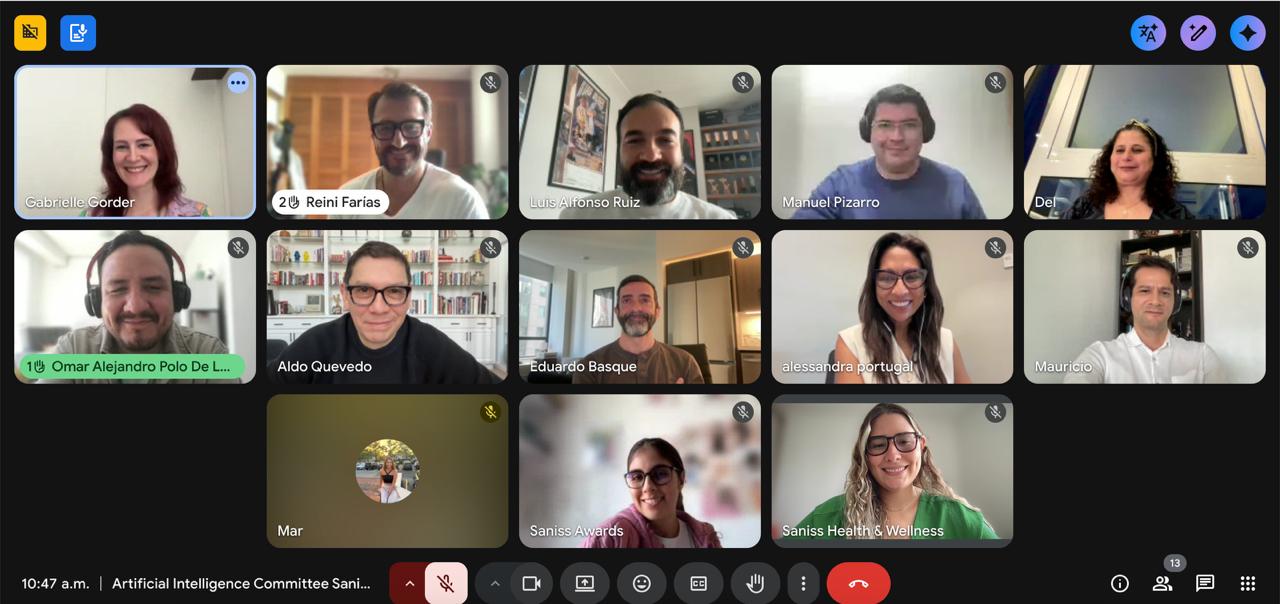
On December 3rd, the Saniss Awards invited Alexandra Gomez, Eduardo Basque, Manuel Pizarro, Aldo Quevedo, Del Sethna, Luis Alfonso Ruiz, Omar Alejandro Polo De La Torre, and Reini Farías to discuss the role of artificial intelligence (AI) in creativity, health and wellbeing communications, ultimately aiming to establish regulations and evaluation criteria for the use AI in festival entries.
The committee debated whether AI-generated pieces should be awarded at festivals and whether they should be in the same categories as human-generated pieces. The general consensus was that AI is a useful tool for creatives that provides speed, but that needs human direction, purpose, curation and refinement, and that its use should not prohibit agencies from participating in festivals. However, the Committee also agreed that disclosure mechanisms (such as checkboxes and AI recognition tools) are necessary to encourage transparency from agencies regarding the use of AI in their submissions.
Several participants emphasized that the core issue at hand is ethics rather than the technology itself, providing examples of “false narratives” and “fake statements.” One Committee member pointed out that AI borrows from billions of existing files, and suggested that similar to citing sources in school, credit should be given for its use.
Committee members compared the sector disruption caused by AI to the emergence of the Computer, Photoshop and Social Media in the past with one Committee member concluding that the focus should be on humans and machines working together to improve health, behavior, and lives and create an impact. Regarding how AI affects sector jobs, one Committee member suggested that AI is not taking jobs but is instead forcing them to evolve, suggesting that creators will assume more editorial and curation roles in the future.
Committee members also agreed on the necessity of AI ethics training for festival judges.