
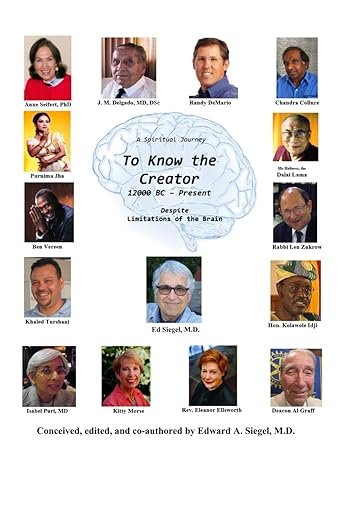
What if the world’s major religions are not competing paths at all, but different expressions of humanity’s shared search to understand the Creator?
Veteran psychiatrist Dr. Ed Siegel discovered that despite centuries of theological differences, every enduring faith tradition has much in common.
In his book, A Spiritual Journey: To Know the Creator Despite Limitations of the Brain, Dr. Siegel draws on more than five decades of psychiatric experience to explore why cultures separated by geography, history and tradition have developed remarkably similar approaches to life’s greatest mysteries.
“I am convinced there is only one true religion,” Dr. Siegel said. “It simply goes by different names, such as Hinduism, Judaism, Christianity, Buddhism, Islam and Vodun.” He explains that while religions often differ in doctrine and practice, they share the same fundamental pursuit: to understand humanity’s relationship with the Creator, to approach communion with the Creator, and to understand and accept the expectations of the Creator.
While traveling through Morocco and Spain, coincidentally for 40 days and 40 nights, Dr. Siegel mused that he “might have an epiphany” that could somehow unite the world’s religions. On day 37 of his journey, while sitting at a table on the Plaza Mayor of Salamanca, Spain, he produced an 85-word statement that, to his surprise, was just what he had hoped to compose. He calls it his “laconic synthesis,” and this sentence became the foundation for A Spiritual Journey.
Furthermore, he has traveled independently to more than 80 countries, visiting cathedrals, churches, mosques, synagogues and temples where he saw the same sense of unity and spirituality on the faces of their adherents.
What follows is his “laconic synthesis”:
“The architectural and bureaucratic infrastructure has, over the millennia, been established for a universally acceptable religion (with varying names and beliefs) that recognizes the limitations of the human brain in perceiving ultimate spiritual truths, yet provides for:
1) a sense of identity and belonging,
2) the expression of awe, faith, gratitude, contrition, hope, generosity, and remembrance;
3) the celebration of life’s major events; and
4) the transmission of those values that teach us right from wrong.
He continues with the statement, “One’s traditional religious beliefs and practices can be just as meaningful yet possibly confining.”
Co-authors representing each of the six major faith traditions contribute their own
chapters; among them are internationally known entertainer and inspirational speaker Ben Vereen; India’s treasured Hindu Kathak dancer Purnima Jha; renowned former Yale professor and researcher Jose Manuel Delgado, M.D., Ph.D.; and Benin West Africa’s former President of Parliament, the Hon. Kolawole Idji. The words of renowned Buddhist teacher and spiritual leader, His Holiness the Dalai Lama, provide a powerful epilogue, ending the book on an optimistic note and urging readers to recognize and respect the commonalities that religious traditions offer humanity.
A Spiritual Journey: To Know the Creator Despite Limitations of the Brain
ISBN-13: 979-8285567172
Available from https://www.amazon.com/dp/B0FCYPYBBZ
ABOUT THE AUTHOR
Edward Siegel, M.D., is a California psychiatrist with more than 50 years of clinical experience. Throughout his career, he has combined interests in medicine, neuroscience, philosophy, spirituality, music and public education.
In addition to his psychiatric practice, he has been active as a lecturer, pianist and community advocate. He received national media attention for his campaign to lower the key of the United States National Anthem so that singers can reach its high notes.
His lifelong interest in the relationship between the human brain and spiritual experience led to the writing of A Spiritual Journey: To Know the Creator Despite Limitations of the Brain.
For more information, please visit www.edsiegelmd.com.