
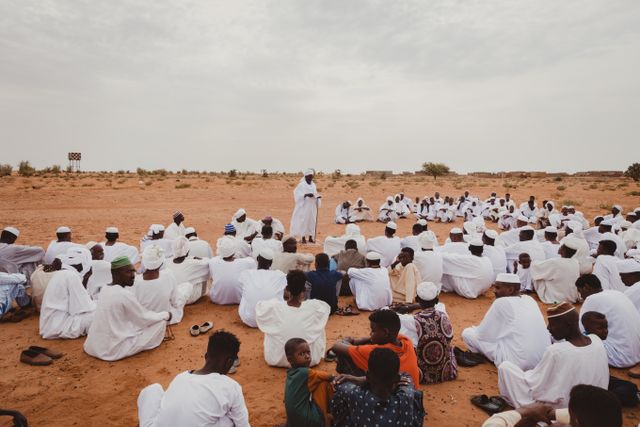
On a spring afternoon in Paris this year, hundreds of Malians gathered not to protest their government, but to defend it.
Dalla Drame, president of the High Council of Malians in France, told reporters the gathering was a way of showing Bamako that relatives across the Mediterranean stood with them, whatever the politics at stake (Africanews, 2026). A few kilometres away, in Montreuil, a deputy mayor made a point of insisting the rally was not really about the junta at all it was about the people (Africanews, 2026).
That distinction support for the nation versus support for the regime is precisely the one the Alliance of Sahel States (AES) has spent three years trying to erase, and the diaspora in Europe is where the erasure is being contested hardest.
Two Diasporas, One Region
Since the coups that brought Assimi Goïta, Ibrahim Traoré and Abdourahamane Tiani to power in Mali, Burkina Faso and Niger between 2020 and 2023, the three juntas have fused into a single political project:The AES confederation emerged from a process that began with the Liptako‑Gourma Charter in September 2023, when Mali, Burkina Faso and Niger created a mutual defence pact, and was formalised as a political confederation in mid‑2024 after the three juntas jointly withdrew from ECOWAS (CISES, 2026; Chatham House, 2025) What is less discussed is how deliberately that project has been exported to the diaspora.
Captain Traoré in particular has been marketed for an international audience. His speeches are subtitled and AI-dubbed into English within hours of delivery, and a 2025 US Africa Command briefing that questioned his use of Burkina Faso’s gold reserves triggered a wave of diaspora-led backlash across social media that Pan-Africanist commentators now treat as a turning point in how the region’s youth abroad see themselves (Toward Freedom, 2025). Nigerien student unions extend this reach formally: the USN, a student body active in 56 of Niger’s 103 departments, explicitly organises Nigeriens abroad alongside those at home, and its leadership describes an “anti-imperialist” alignment with the ruling council that goes well beyond passive sympathy (Brasil de Fato, 2025).
But this is not a uniform diaspora chorus. Amnesty International and the International Federation for Human Rights have documented a harsher pattern back home: dissolved political parties, disappeared activists, and a February 2026 prison sentence for a former Malian prime minister over a single social media post expressing solidarity with detained critics (Global Centre for the Responsibility to Protect, 2026). Exiled opposition voices and independent journalists in Europe are the least visible part of this story precisely because visibility now carries a cost for their relatives at home which is itself a form of leverage exercised across borders.
The result is a diaspora being pulled in two directions by the same regimes: mobilised abroad as a legitimacy chorus, while critical voices abroad calculate the risk to family still inside AES territory.
The Financial Front
The pressure is not only rhetorical. In December 2025, the three AES finance ministries jointly launched the Confederal Investment and Development Bank (BCID-AES) with initial capital of roughly $895 million, explicitly framed as a break from the CFA franc system and the regional central bank, the BCEAO (Ecofin Agency, 2025). Niger’s finance minister called it a step toward “sovereignty of financing” for a bloc built on Mali and Burkina Faso’s gold reserves and Niger’s uranium (Ecofin Agency, 2025).
This is where diaspora politics stops being symbolic. Remittances to Sub-Saharan Africa already function as a larger and steadier flow than foreign direct investment in several economies (ODI, 2025), and governments across the continent from Senegal’s first diaspora bond issuance in September 2025 to a pending US congressional bill on diaspora finance instruments are actively trying to convert that goodwill into sovereign capital (Seneweb, 2026; Congress.gov, 2025). An AES bloc that has cut itself off from ECOWAS and much of its traditional European financing has every incentive to court the same diaspora loyalty it is cultivating politically. Whether that translates into an AES diaspora bond, informal capital flight from BCEAO-linked accounts, or simply sustained remittance volume despite Western sanctions pressure, is a question worth watching rather than one that has been settled.
Why the Split matters more than either Side admits
The debatable claim at the centre of this piece is simple: neither the pro-junta diaspora rallies nor the exiled opposition networks are disinterested. Both are being courted, and both carry real stakes for the people mobilising.
The pan-Africanist framing, Traoré as heir to Thomas Sankara, French troops expelled, a “fourth revolution” uniting the bloc (Toward Freedom, 2025) offers a genuinely appealing narrative of sovereignty after decades of French military and monetary presence in the region. It is not manufactured from nothing; the underlying grievances about CFA franc dependency and French security failures against jihadist expansion are well documented (European Union Institute for Security Studies, 2025). But the same narrative is now the state’s primary tool for managing dissent, both at home where OCHA recorded 3,737 security incidents and 9,362 deaths across the central Sahel in 2025 alone (Global Centre for the Responsibility to Protect, 2026) and abroad, where it asks emigrants to perform loyalty publicly.
Set against that is a diaspora of exiles, students and journalists who left in part because of the juntas, and whose caution about speaking out is rational rather than passive. Reading the Paris rally in support of Bamako as representative of “the diaspora” misses that the diaspora is not one constituency; it is a battlefield over whose version of solidarity counts as authentic.
What Comes Next
The open question is whether Europe’s Sahelian communities become a genuine diplomatic channel a route through which AES states extract capital, legitimacy and quiet compliance from citizens abroad or whether the harder-to-see opposition networks eventually reassert themselves the way Malian civil society briefly did in May 2025, when hundreds took to Bamako’s streets in the first open display of dissent since 2020
For diplomacy scholars, that question sits squarely inside the maritime-and-transnational-security literature this publication has covered before: coercion no longer needs a gunboat when it can be exercised through a remittance app, a diaspora rally, or the threat of a relative’s arrest. The Sahel’s coup belt has simply moved that contest onto European soil.
References
Africanews (2026) Malian diaspora in Paris gathers in support of Bamako’s ruling junta. Available at: https://www.africanews.com/2026/04/28/malian-diaspora-in-paris-gathers-in-support-of-bamakos-ruling-junta/ (Accessed: 5 July 2026).
Brasil de Fato (2025) ‘I hate France, but I speak French’: youth lead the fight against neocolonialism in the Sahel region. Available at: https://www.brasildefato.com.br/2025/04/17/i-hate-france-but-i-speak-frenchyouth-lead-the-fight-against-neocolonialism-in-the-sahel-region/ (Accessed: 5 July 2026).
Centre for International Security & European Strategy. The Sahel’s New Security Architecture: From the Liptako‑Gourma Charter to the AES Confederation.
Chatham House. The Alliance of Sahel States and the Reordering of West African Regionalism.
Congress.gov (2025) H.R.4586 – AIDA, 119th Congress (2025–2026). Available at: https://www.congress.gov/bill/119th-congress/house-bill/4586/text (Accessed: 5 July 2026).
Ecofin Agency (2025) AES Launches Confederal Investment Bank: A Strategic Pivot Toward Sahelian Financial Sovereignty. Available at: https://www.ecofinagency.com/news-finances/2412-51643-aes-launches-confederal-investment-bank-a-strategic-pivot-toward-sahelian-financial-sovereignty (Accessed: 5 July 2026).
European Union Institute for Security Studies (2025) The multi-aligned Sahel: Reframing the EU’s role in a crowded region. Available at: https://www.iss.europa.eu/publications/briefs/multi-aligned-sahel-reframing-eus-role-crowded-region (Accessed: 5 July 2026).
Global Centre for the Responsibility to Protect (2026) Central Sahel (Burkina Faso, Mali and Niger). Available at: https://www.globalr2p.org/countries/mali/ (Accessed: 5 July 2026).
ODI (2025) From remittances to bonds: mobilising diaspora finance in African economies. Available at: https://odi.org/en/insights/from-remittances-to-bonds-mobilising-diaspora-finance-in-african-economies/ (Accessed: 5 July 2026).
Seneweb (2026) Investing from abroad in Senegal’s recovery: Everything you need to know about Diaspora Bonds. Available at: https://www.seneweb.com/en/news/Economie/investir-depuis-letranger-dans-le-redressement-du-senegal-tout-comprendre-sur-les-diaspora-bonds_n_468391.html (Accessed: 5 July 2026).
Toward Freedom (2025) Pan Africanism in the Sahel Region. Available at: https://towardfreedom.org/story/archives/africa-archives/pan-africanism-in-the-sahel-region/ (Accessed: 5 July 2026).
By: Eric Muhia

Eric Muhia
Eric Muhia is a dynamic professional at the intersection of sustainable energy transitions and international cooperation, specializing in EV smart charging consultancy and energy sector advisory. With dual MSc degrees-one in International Business & Strategy from the University of Dundee and another in Diplomacy & International Security from the University of Strathclyde-Eric brings a distinctive blend of technical expertise, strategic insight, and diplomatic acumen to every project he undertakes. Driven by a commitment to the United Nations Sustainable Development Goals, Eric bridges technology, business strategy, and international diplomacy to deliver scalable solutions. A diplomacy enthusiast and advocate for sustainable development, Eric is eager to connect with forward-thinking professionals and organizations focused on sustainable energy, climate action, and global development. Together, he believes,it is possible to harness innovation and cooperation to build resilient, low-carbon communities worldwide-transforming the geopolitical and economic landscape of our net-zero future.
Author Image Attribution: Eric Muhia